 Myopia surgery
 Myopia prevention and control
 Presbyopia
 Cataract
 Dry eye
 400-8600-525
 CN
 One City, Three Campuses

We keep a close watch on visual acuity and axial length, yet there are still children whose myopia is not well controlled, with the prescription increasing by more than 75 degrees every year. What should be done in such a case? Let us take a look together at the MRT examination.
1. How MRT Helps Identify the Cause of Myopia
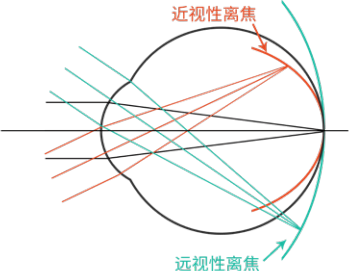
It is easy to understand if we compare the eye to a camera: ordinary refraction only looks at the central picture of the camera, but what truly determines how fast myopia progresses is the optical defocus signal coming from the periphery, which can override the central retinal signal and dominate the refractive development of the central retina.When the image at the edge of the fundus is misaligned, it producesharmful defocus, which continuously elongates the axial length, and myopia becomes deeper and deeper. Myopia control spectacles and orthokeratology lenses on the market are all designed at their core to correct this defocus, but every child's ocular conditions are different, so it is difficult for mass-produced lenses to fit precisely.By contrast,MRT multispectral refraction topographyis a non-invasive examination designed specifically to detect this hidden problem: no pupil dilation is needed throughout the process, the child does not need to turn the head to cooperate, with only2 to 3 secondsneeded for each eye.

The instrument automatically generates a color-coded fundus defocus map, which parents can understand at a glance:
Red and yellow areas: peripheral hyperopic defocus signals, which can promote axial elongation
Blue and green areas: myopic defocus signals, which can slow down axial growth.
Without any obscure technical jargon, it provides a direct view of the true state of the child's fundus and pinpoints the root cause of uncontrolled myopia.
2. Four Core Functions of MRT: Putting an End to Blind Eye Care
1.For children with normal vision: early warning, prevention before onset
Many children have intact vision and still have hyperopic reserve, yet large areas of harmful defocus have already appeared in the fundus, placing them in the high-risk group for myopia. Ordinary examinations cannot detect this at all; by the time vision declines and a prescription appears, irreversible changes have already taken place in the development of the eye. MRT can capture the precursors of myopia 1 to 2 years in advance, so that prevention comes before the onset of myopia.
2.For children who are already myopic: finding the root cause of the rising prescription
With the same defocus lenses, why is myopia well controlled in other children but not in your own? By comparing MRT reports taken before and after wearing the lenses, it is possible to see clearly whether the lenses have filled the defocus gap at the fundus, and to judge precisely whether the control plan is a good fit, putting an end to blind lens fitting and ineffective myopia control.
3For follow-up visits: dynamic monitoring of eye development
Myopia control is a long and protracted battle; looking only at the prescription and axial length is far from enough. Regular MRT re-examinations make it possible to visually track changes in fundus defocus, judge whether the current control method remains effective, adjust the plan as needed, and precisely manage the pace of the child's eye development.
4.Friendly to young children: non-invasive and painless, stress-free re-examination
The whole process involves no contact, no intense light stimulation and no dilating eye drops, and there is no ocular discomfort, so even very young children can cooperate with ease, making it suitable for long-term repeated monitoring.
Q:Is the MRT examination safe? Will it harm the eyes?
A: You can rest assured. It is purely optical imaging, with no radiation, no eye drops and no contact with the eye, and there is no invasive procedure of any kind. Children and adolescents can be re-examined repeatedly, and it is currently a standard screening item for myopia control in hospitals.
Scientific eye care does not mean following the trend of buying myopia control glasses or simply increasing the time spent outdoors; it means understanding the true condition of your own child's eyes. One more precise examination means one less blind attempt, so that objective data can be used to protect the child's long-term clear vision.

Du Yuqin
Director of the Optometry Center, Beijing Ming Vision & Ophthalmology
Attending Physician, Doctor of Medicine
Thesis Advisor for the Optometry Program at Chengdu University of Traditional Chinese Medicine
Member of the Asian Branch of the International Association of Orthokeratology (IAOA)
She studied under Professor Zhou Yuehua, a renowned expert in corneal refractive surgery in China, and has been engaged in ophthalmic clinical work as well as optometry for many years, with a focus on corneal refractive surgery together with the design of myopia correction plans.
She has participated in a number of national and provincial-level research projects, published more than 20 papers in SCI-indexed journals and Chinese core journals, obtained three national invention patents, and serves as a reviewer for international journals such as the International Journal of Ophthalmology and PLOS One.
She has long been engaged in the evaluation of myopia correction surgery and the formulation of personalized plans, and has accumulated extensive experience in adolescent myopia control as well as visual function management.
Areas of expertise:
SMILE (small incision lenticule extraction) myopia correction surgery, FS-LASIK myopia correction surgery, diagnosis of high myopia and complex refractive errors together with the design of correction plans, keratoconus assessment and corneal cross-linking (CXL), myopia control and progression management in children and adolescents, fitting of orthokeratology (OK) lenses, RGP and scleral lenses, as well as the diagnosis and treatment of common pediatric eye diseases such as strabismus and amblyopia
 Online Booking

 Tel
 WeChat

 Address

 Consult